
💡 Why sentiment labels matter?
Exerta reads every comment on your posts and ads and assigns it a sentiment label. Those labels are what your rules use to decide what to do - hide a comment, send a reply, trigger a DM, or ignore it entirely. If your rules use the wrong sentiment labels, you’ll miss comments you should be acting on, or act on ones you shouldn’t. Getting this right is what makes your automation accurate.🏷️ The four sentiment labels
Exerta classifies every comment into one of four labels.Positive
Positive comments are clearly favourable - compliments, praise, and enthusiasm. It can also include brand fans or people who have tried the product/service and giving positive feedback. Examples:- “This is exactly what I needed!”
- “Love this product, been using it for months”
- “So me 😍”
- “This is literally me”
- “I love it!”
- “I’ve been using this and it’s been life-changing!”
📋 Note: Comments that express personal affinity or recognition (“this is so me”, “same!”) are often classified as Positive even if they don’t contain obvious praise. These are potential buyers showing strong affinity with your ad.
Interested
Interested comments show clear buying intent or curiosity about the product - asking questions, requesting information, or signalling they want to know more. Examples:- “How much does this cost?”
- “Where can I get this?”
- “Does this ship to Australia?”
- “Send me the link”
- “What’s the promo code?”
💡 Interested is your highest-intent label. These are people actively asking about your product. A DM rule targeting Interested only is the most targeted approach for lead generation.
Neutral
Neutral comments are neither positive nor negative - general observations, off-topic remarks, vague reactions, or short responses that don’t signal clear sentiment. Examples:- “Hm”
- “Really?”
- “Hmm interesting”
- “Wow”
- “Oh”
- 👋 😊 👀 (single emoji reactions)
- General questions unrelated to buying
⚠️ Neutral doesn’t mean uninterested. Many comments from genuinely curious or interested people get classified as Neutral because they haven’t expressed explicit buying intent yet. A customer replying “hmm interesting” to your ad is worth reaching out to - they just haven’t asked a direct question. Always include Neutral in your reply and DM rules.
Negative
Negative comments express complaints, criticism, hostility, or dissatisfaction. Examples:- “This is a scam”
- “Doesn’t work at all”
- “Total waste of money”
- “Stop spamming my feed”
- Hostile or offensive comments
💡 Hiding a negative comment doesn’t end the conversation. The commenter can still see their own comment and will still receive any reply or DM you send them. This means you can hide a complaint from public view and still send a private DM to address it - turning a negative experience around without others seeing it.
⚠️ How sentiment detection works in practice
Exerta’s sentiment detection is AI-powered but not perfect. A few things to know: Sarcasm and mockery often slip through as Neutral or Positive. A comment like “yeah right 😂” or “sure it does 🙄” may be classified as Neutral or even Positive because the words themselves don’t signal negativity. If you notice a comment has been misclassified, find it in Live Comments and adjust the sentiment label manually. This trains the agent to recognise similar comments correctly in future - but only if Moderation Learning is enabled in your settings. See Understanding Processing Mode.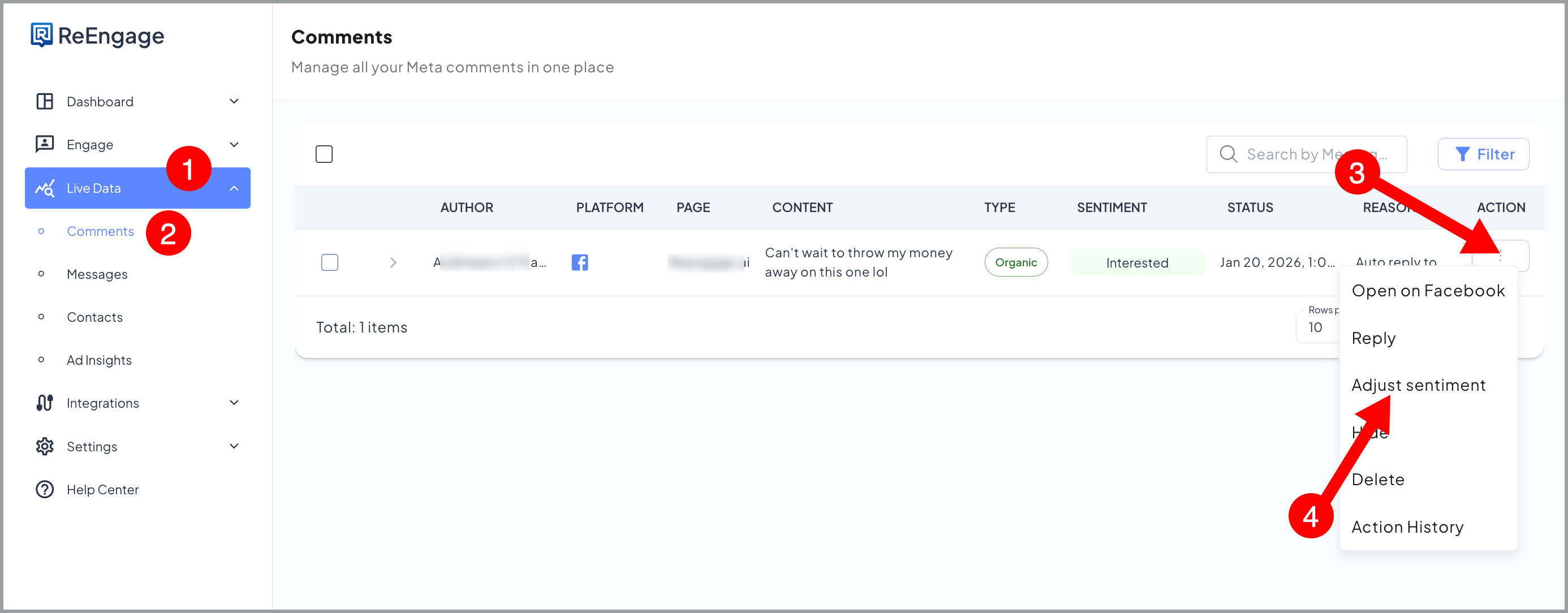
📋 The practical takeaway: Always include Neutral, Interested, and Positive in your reply and DM rules. Relying on Interested only will miss a large portion of your genuine potential customers.
📋 Which labels to use for each rule type
Use this as your reference when setting up rules.⚠️ Don’t use Interested only for your main DM rule. You’ll miss the majority of people who are curious but haven’t asked a direct question yet. These are real potential customers - they just need a nudge.
❓ FAQs
🔍 Q: What are the four sentiment labels in Exerta? Exerta classifies every comment into one of four sentiment labels:- Positive - compliments, praise, enthusiasm, and strong personal affinity
- Interested - clear buying intent, questions about price, requests for links or info
- Neutral - vague reactions, short comments, single emojis, general observations
- Negative - complaints, criticism, hostility, or offensive comments
🎯 Q: Why is a clearly interested comment being classified as Neutral? If a comment shows curiosity but doesn’t contain a direct buying signal (like asking for a price or a link), Exerta will often classify it as Neutral rather than Interested. Comments like “hmm interesting”, “really?”, or a single emoji reaction are common examples. This is expected behaviour - include Neutral in your DM and reply rules so these comments don’t get missed.
⚠️ Q: A negative comment isn’t being hidden. What could be wrong? There are two common causes:
- Negative is not selected in your hide rule’s Sentiment Labels - it is not pre-selected by default. Open your hide rule and confirm Negative is manually selected.
- The rule’s Moderation Target doesn’t match the platform the comment appeared on. An Instagram rule will not catch Facebook comments, and vice versa.
- The comment may have been misclassified. Find the comment in Live Comments, check the sentiment label assigned to it, and adjust it if it’s wrong. For example, a sarcastic comment may have been classified as Positive instead of Negative. Adjusting it manually trains the agent to recognise similar comments correctly in future. but only if Moderation Learning is enabled. See Understanding Processing Mode.
🔍 Q: Should I include Negative in my reply or DM rules? You can, and in some cases it’s worth doing. Hiding a negative comment removes it from public view, but the commenter can still receive a reply or DM. Sending a private message to someone who left a complaint - acknowledging their experience and offering help - can turn a negative interaction around without anyone else seeing the original comment.
🎯 Q: What is the difference between Interested and Positive? Interested comments contain explicit buying signals - questions about price, availability, or how to get the product. Positive comments express enthusiasm, affinity, or praise without necessarily asking to buy. Both are worth acting on, but Interested represents higher immediate intent.